

Last Updated: November 17, 2026
Quick Summary
A dental practice regulatory compliance solution combines written policies, staff training, documentation systems, and audit support to keep your office aligned with HIPAA, OSHA, DEA, Medicaid, and infection control rules. We build these systems for independent offices and small to mid-market dental service organizations, pairing each policy with the logs and records that prove it is followed.
- Name a compliance officer who owns the manual, training log, and audit calendar.
- Run a quarterly self-audit covering policy currency, training records, sterilization logs, controlled substances, and business associate agreements.
- Training completed but not documented is treated the same as training never done.
- The HIPAA & OSHA/Infection Control Manual Bundle is priced at $739.94.
- A vendor that cannot produce a signed business associate agreement is a compliance risk regardless of price.
Table of Contents
- What a Dental Practice Regulatory Compliance Solution Must Cover
-
Building a Dental Compliance Program That Survives an Inspection
- Step 1: Assign ownership and scope (weeks 1-2)
- Step 2: Build the written foundation (weeks 2-6)
- Step 3: Map training to roles (weeks 4-8)
- Step 4: Stand up the audit cycle (weeks 6-10)
- Step 5: Close the loop with incident reporting (ongoing)
- Step 6: Schedule recurring review (ongoing)
- Metrics that show the program is working
- Dental Compliance Training: Getting Staff Trained and Keeping Records
- Running a Dental Practice Compliance Audit Before Regulators Do
- When a Dental Compliance Consultant Earns the Fee
- Comparing Dental Compliance Solutions: Manuals, Training, and Bundles
- Book a Call to Map Your Practice's Compliance Gaps
- Frequently Asked Questions
What a Dental Practice Regulatory Compliance Solution Must Cover
A dental practice regulatory compliance solution combines written policies, staff training, documentation systems, and audit support to keep a dental office aligned with federal and state rules. It covers HIPAA privacy and security, OSHA workplace safety, DEA controlled-substance handling, Medicaid billing rules, and infection control. At Dental Compliance, we build these systems for independent offices and small to mid-market dental service organizations.
The stakes are not theoretical.
The Rules Behind the Paperwork: HIPAA, OSHA, DEA, and Medicaid
Four regulatory areas drive most dental compliance work, and each one asks for something different.
HIPAA governs protected health information.
OSHA covers workplace safety: bloodborne pathogen standards, hazard communication, fire and electrical safety, injury prevention, and an exposure control plan.
DEA applies to any dentist who orders, stores, or administers controlled substances, including sedation and anesthesia providers.
Medicaid compliance involves provider enrollment, documentation standards, and billing integrity. Errors here can trigger recoupment.
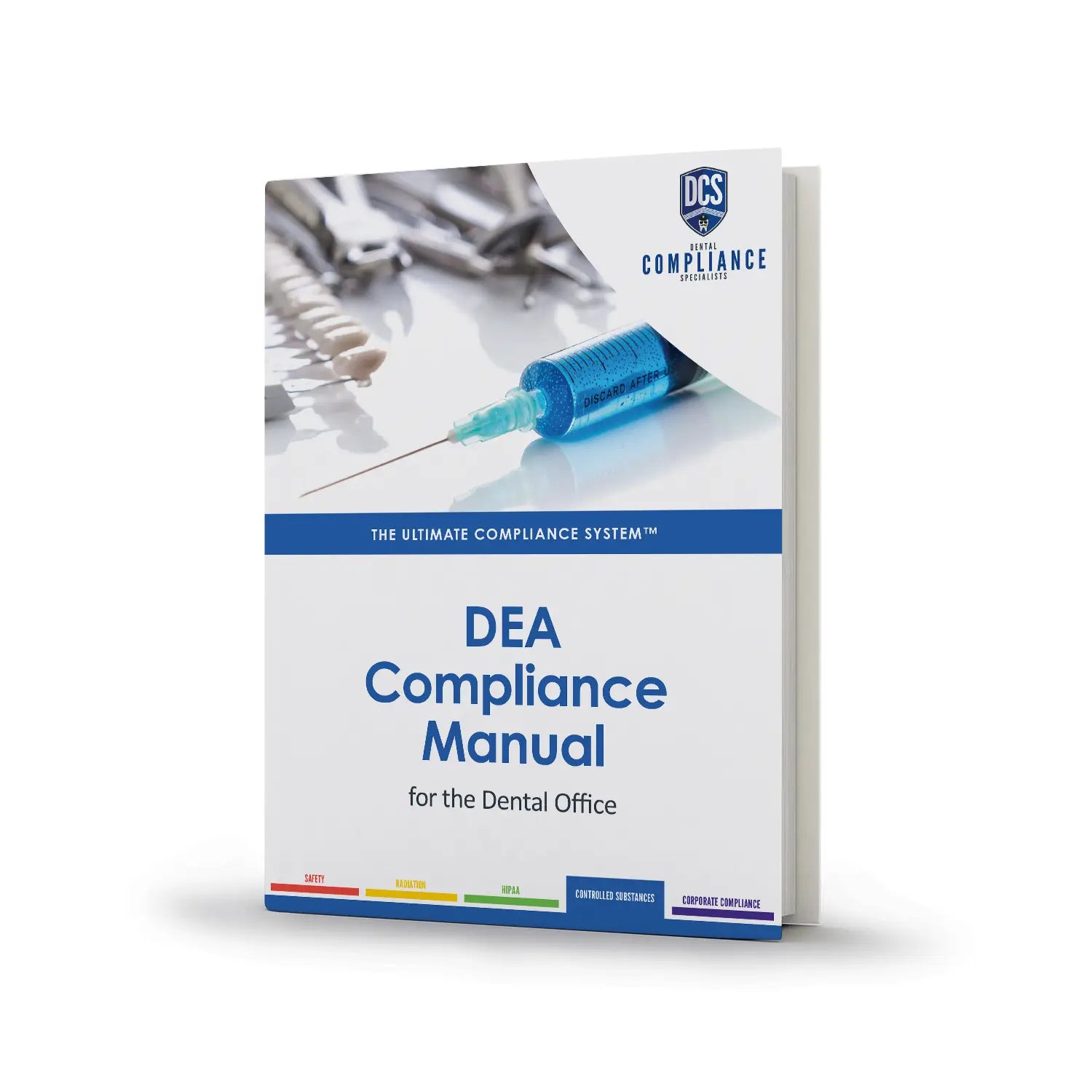
A CDC infection control guidance for dental settings rounds out the picture with sterilization and instrument-processing standards. If your DEA program needs a written backbone, our DEA compliance manual includes the policies, checklist, and forms sedation providers are expected to keep.
Building a Dental Compliance Program That Survives an Inspection
A dental compliance program works when it is written down, assigned to a named person, and reviewed on a schedule. Inspections reward evidence, not intentions.
Step 1: Assign ownership and scope (weeks 1-2)
Name a compliance officer, even in a small office. That person owns the manual, the training log, and the audit calendar. In a multi-location practice, name a site lead at each location and a single program owner at the top. Scope the program by listing every regulation that applies to your services: HIPAA, OSHA, DEA if you handle controlled substances, Medicaid if you bill it, and infection control under CDC guidance.
Step 2: Build the written foundation (weeks 2-6)
Draft or customize written policies for each applicable regulation, and include a business associate agreement process for any vendor that touches protected health information. Pair each policy with the form or log that proves it is followed, such as a sterilization log, an exposure control plan, or a controlled-substance inventory sheet.
Step 3: Map training to roles (weeks 4-8)
Build a training matrix showing which courses each role needs and when. Assign completion dates for new hires and annual renewals, and decide where certificates and signed acknowledgments are stored so they can be produced on request.
Step 4: Stand up the audit cycle (weeks 6-10)
Set a quarterly self-audit covering policy currency, training records, sterilization and infection control logs, controlled-substance documentation, and business associate agreements. Score each area pass or fail, record the evidence checked, and assign a correction date and owner for every failure.
Step 5: Close the loop with incident reporting (ongoing)
Create an incident reporting and corrective-action process so problems found in audits, staff reports, or near misses are logged, assigned, and closed with evidence. Review open items at each quarterly meeting.
Step 6: Schedule recurring review (ongoing)
Put a recurring review on the calendar: quarterly self-audits, annual policy review, and a check whenever a regulation changes or the practice adds a service such as sedation. The most common mistake we see is a program built once and never touched.
Metrics that show the program is working
Track a small set of measures and report them at each quarterly review.
| Metric | What it tells you | Review cadence |
|---|---|---|
| Training completion rate by role | Whether new hires and renewals are current | Monthly |
| Overdue training count | Where follow-up is needed | Monthly |
| Audit items failed and closed | Whether corrective actions are sticking | Quarterly |
| Open corrective actions past due | Whether ownership is working | Quarterly |
| Incident reports opened vs. closed | Whether the reporting loop is functioning | Quarterly |
| Business associate agreements on file | Whether vendor coverage is complete | Quarterly |
| Policy review date vs. last update | Whether the manual is current | Annually |
For a deeper look at making compliance part of daily work rather than an annual scramble, read building a culture of compliance.
Watch out: if the compliance officer role sits with someone who also owns front-desk scheduling and billing, the audit calendar is usually the first thing dropped during a busy month.
Dental Compliance Training: Getting Staff Trained and Keeping Records
Training is the piece most practices underestimate. Every team member needs role-specific courses, and every course needs a completion record you can produce on request.
Dentists, hygienists, assistants, lab technicians, and front-office staff do not need identical training.
A practical training calendar looks like this:
| Role | Core Annual Courses | Records to Keep |
|---|---|---|
| Dentist | Bloodborne pathogens, HazCom, HIPAA privacy, cybersecurity | Completion certificates, signed acknowledgment |
| Hygienist / Assistant | Bloodborne pathogens, HazCom, HIPAA privacy, emergency prep | Completion certificates |
| Lab technician | Bloodborne pathogens, HazCom, silica safety, radiation | Completion certificates |
| Front office | HIPAA privacy, PCI DSS, cybersecurity awareness | Completion certificates |
Our compliance training catalog covers these modules by role, so new hires and annual renewals follow the same path. Watch out: training completed but not documented is treated the same as training never done.
Running a Dental Practice Compliance Audit Before Regulators Do
A dental practice compliance audit is a structured self-review that finds gaps before an inspector does. Done quarterly, it turns compliance into a maintenance task.

A workable audit covers five areas: policy currency, training records, sterilization and infection control logs, controlled substance documentation, and business associate agreements. Score each area pass or fail, note the evidence you checked, and set a correction date for anything that fails.
Staff turnover is the quiet killer here. Our article on when key employees leave covers six ways to keep OSHA, infection control, X-ray EPEs, and sensor QA/QC on track through transitions.
When a Dental Compliance Consultant Earns the Fee
A dental compliance consultant earns the fee when your practice lacks the internal time or expertise to build and maintain the program, or when you are preparing for an inspection and need an outside set of eyes.
Not every practice needs a consultant. A consultant may be useful when a practice is opening a second location, moving to a DSO structure, adding sedation services, or recovering from a citation.
Comparing Dental Compliance Solutions: Manuals, Training, and Bundles
Compliance solutions fall into three broad categories: customized manuals, on-demand training, and bundled systems that combine both. A fourth option, managed compliance software or a consultant retainer, adds ongoing monitoring and support. The right choice depends on how much of the program you want to build yourself, how many locations you operate, and whether you need integration with your practice-management system.
Rather than start with a product list, start with a scorecard.
| Evaluation criterion | What to ask | Why it matters |
|---|---|---|
| Regulatory coverage | Does it address HIPAA, OSHA, DEA, Medicaid, and infection control, or only one area? | A partial solution leaves gaps that inspectors find first |
| Customization | Are policies built around your practice's answers, or is it a generic template? | Generic manuals often describe workflows your office does not follow |
| Training included | Are role-specific courses bundled, and are completion records tracked? | Training without documentation is treated as not done |
| Update cadence | How often are policies and courses refreshed when rules change? | A manual from three years ago may no longer match current requirements |
| Implementation support | Is there a guide, walkthrough, or onboarding call? | Manuals without an implementation path are rarely opened |
| Audit and inspection support | Does it include self-audit checklists, corrective-action tracking, or inspection prep? | Evidence, not intentions, is what inspectors review |
| Integration and data handling | Does software connect to your practice-management system, and how is access controlled? | Poor integration creates duplicate entry and stale records |
| Vendor due diligence | Can the vendor provide a business associate agreement, security documentation, and references? | Any vendor touching patient data must be covered by a BAA |
| Total cost of ownership | What are the upfront, renewal, training, and support costs? | A low sticker price can hide recurring fees |
| Scalability | Can it standardize policies and training across multiple locations? | Multi-site practices need one source of truth |
Customized manuals. Best when you want to own the program and need practice-specific policies.
On-demand training. Best for annual and new-hire refreshers.
Bundled systems. Best for practices that need both core programs built at once.
Software and consultant retainers. Best when you want ongoing monitoring, dashboards, and outside expertise.
Here are the Dental Compliance options and their listed prices:
| Solution | Price | What It Covers | Best For |
|---|---|---|---|
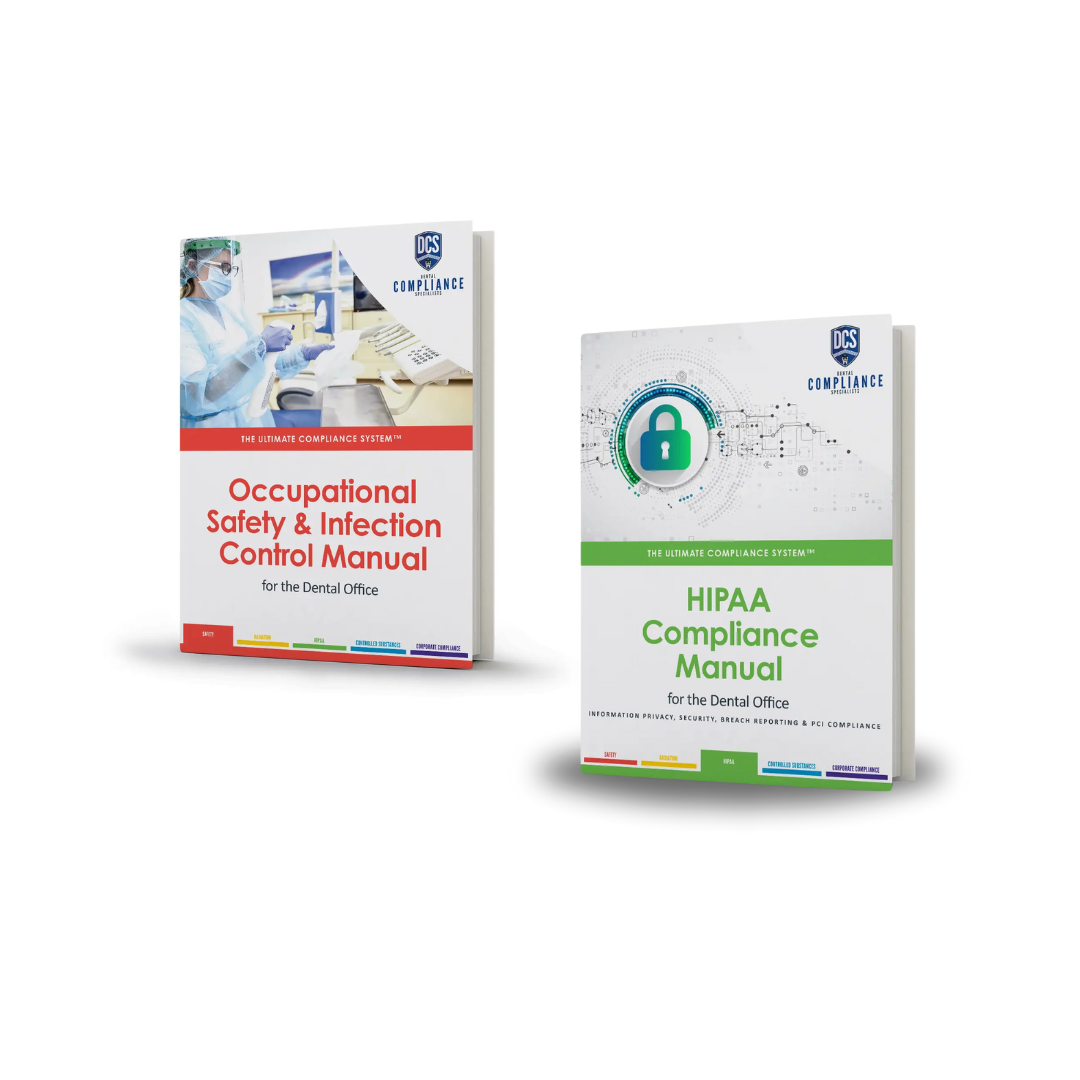
| HIPAA & OSHA/Infection Control Manual Bundle | $739.94 | Custom HIPAA and OSHA manuals, BAA manual, training packets, housekeeping checklist | Practices that need both core programs built at once |
| HIPAA Compliance Manual | $449.97 | Privacy, security, breach notification policies, custom forms, BAA manual | Offices that already have OSHA handled |
| OSHA Safety & Infection Control Manual | $389.97 | Bloodborne pathogens, HazCom, injury prevention, infection control | Offices that already have HIPAA handled |
| DEA Compliance Procedure Manual | $297.00 | Controlled substance policies, DEA checklist, designated agent forms | Sedation and anesthesia providers |
| No Surprises Act Toolkit | $497.00 | Good faith estimate forms, instructional video, phone log | Practices billing uninsured and self-pay patients |
| OSHA Training (on demand) | $29.00 | Bloodborne pathogens, HazCom, emergency prep, ergonomics | Annual and new-hire training |
| HIPAA Training (on demand) | $29.00 | HIPAA privacy, PCI DSS, cybersecurity awareness | Annual and new-hire training |
Price
Book a Call to Map Your Practice's Compliance Gaps
The hardest part of dental compliance is not knowing which rule applies. It is knowing which of your current records would fail an inspection today.
Dental Compliance works with independent dentists and small to mid-market DSOs on customized compliance programs, expert training, and audits, with a focus on OSHA, HIPAA, DEA, and Medicaid.
Most practices do not fail inspections because they ignored the rules. They fail because a log went unkept or a training certificate went missing.
Frequently Asked Questions
What regulations apply to a dental practice?
Federal rules include HIPAA's Privacy, Security, and Breach Notification Rules, OSHA's Bloodborne Pathogens and Hazard Communication standards, and DEA requirements for practices that order, store, or administer controlled substances. The No Surprises Act also requires good faith estimates for uninsured and self-pay patients. On top of that, state dental boards set infection control and radiation rules, and Medicaid participation adds its own documentation conditions. A workable dental compliance program maps each rule to a written policy, a trained employee, and a record you can produce on request.
How often should a dental practice conduct a compliance audit?
Run a full dental practice compliance audit at least once a year, and repeat targeted checks more often, especially when a regulation changes or you add a location. The point is to find gaps while you can still fix them quietly. An audit that turns up a missing business associate agreement or an expired training record is far cheaper than the same finding during an OSHA or OCR investigation.
Do dental practices need a compliance consultant?
A single-location practice can often handle compliance with well-built manuals, annual dental compliance training, and a disciplined audit calendar. A dental compliance consultant earns the fee when you run multiple locations, pursue sedation permits, operate across state lines, or have gone years without a real audit. The practical test: if no one in the office can name your last risk assessment date and produce the training records for every employee, an outside review can surface findings you would rather hear about from a consultant than an inspector.
What should a dental compliance program include?
At minimum: written HIPAA and OSHA policies customized to your office, annual and new-hire training with completion records, a risk assessment, business associate agreements for every vendor touching patient data, infection control and sterilizer documentation, and an incident reporting process with corrective actions. Practices with controlled substances need DEA policies covering ordering, storage, and inventory. Build it as a living system with an owner and a review date, not a binder that gets filed after purchase and never opened again.
What are the risks of noncompliance for a dental practice?
The financial exposure is real. Case law cited on Dental Compliance's HIPAA manual listing references settlements for failing to have an executed business associate agreement with a vendor. OSHA can cite practices under the General Duty Clause for hazards well beyond the obvious ones, including nitrous oxide safety and hazard communication gaps. Add state board discipline, Medicaid billing audits, and reputational damage, and the cost of a $739.94 manual bundle looks small against a single finding.
